Astrophotography ranges from single untracked exposures taken with a camera on a tripod to multi-hour tracked sessions imaging faint galaxies and nebulae. The techniques and equipment at each level are quite different, but the progression from one to the next is gradual and each stage produces meaningful results.
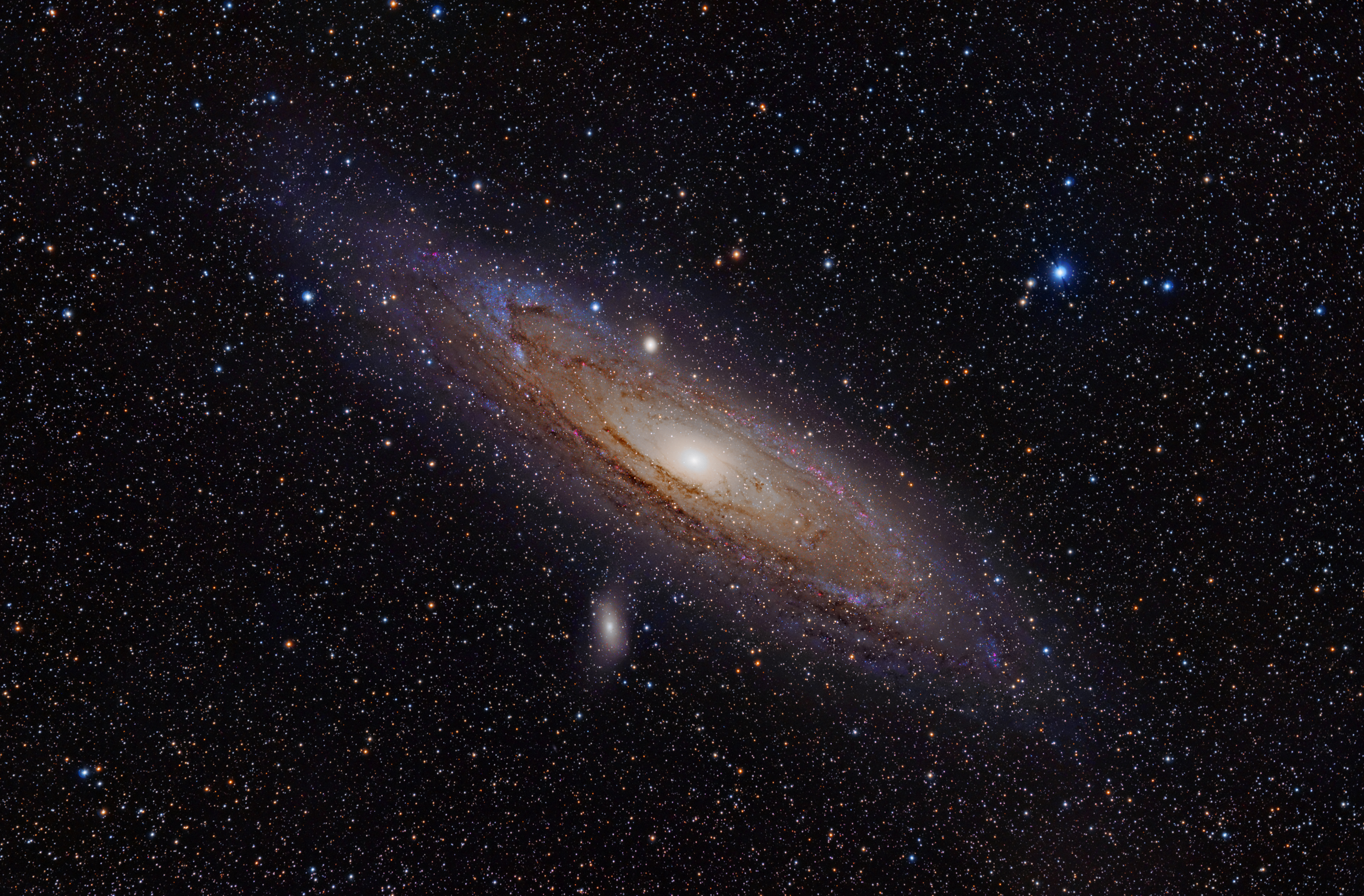
Stage 1: Wide-field without a tracker
The simplest form of astrophotography requires only a camera with manual exposure control and a stable tripod. Any mirrorless or DSLR body is suitable. Compact cameras with full manual mode can also work, though results depend heavily on sensor size and low-light performance.
Basic settings
For a fixed (untracked) setup, exposure length is limited by star trailing — the apparent movement of stars as Earth rotates. A commonly used approximation is the "500 rule": divide 500 by the focal length of the lens to get the maximum exposure in seconds before trailing becomes visible on a full-frame sensor. For a 24mm lens on a full-frame camera, this gives approximately 20 seconds.
A more accurate formula accounts for crop factor and declination, but for early experiments the 500 rule provides a practical starting point.
| Focal length (full-frame) | Max exposure (approx.) | Suitable target |
|---|---|---|
| 14–16mm | 30–35 sec | Milky Way panoramas |
| 24mm | ~20 sec | Constellation framing |
| 35mm | ~14 sec | Orion, Pleiades area |
| 50mm | ~10 sec | Individual constellation sections |
ISO settings between 1600 and 6400 are typical for night sky work; the optimal value depends on the sensor's noise characteristics. Most modern DSLR and mirrorless bodies perform acceptably at ISO 3200. It is preferable to capture multiple shorter exposures and stack them in post-processing rather than a single very long exposure, which accumulates more noise.
Shooting in RAW format preserves the full tonal range of the sensor data. JPEG compression clips highlight and shadow detail that is difficult to recover in post-processing.
Stage 2: Tracked wide-field imaging
A star tracker — a motorised mount that compensates for Earth's rotation — allows significantly longer exposures without star trailing. Entry-level trackers from manufacturers such as Sky-Watcher (Star Adventurer series) and iOptron (SkyGuider Pro) are compact and can be polar-aligned within a few minutes.
With a tracker and a 50mm lens, sub-exposures of 2–4 minutes are achievable at a dark site. Stacking 20–30 such frames produces images with signal-to-noise ratios that reveal structure in nebulae and galaxy halos that a single short exposure cannot reach.
The Milky Way's galactic centre is not visible from Poland — it passes south of the horizon from Polish latitudes. The winter Milky Way arm (towards Auriga and Perseus) and the summer arm (towards Cygnus and Sagittarius) are both photographable, with the summer arm being more prominent though lower in the southern sky.
Polar alignment
Accurate polar alignment is the most important step for tracking accuracy. Most modern trackers include a polar alignment scope or support software-assisted alignment. In the northern hemisphere, Polaris (the North Star) lies within approximately 0.7° of the celestial pole, making it a useful reference point.
For exposures under 3–4 minutes, drift from moderate polar alignment errors is typically manageable with standard image-stacking software (Sequator, DeepSkyStacker). For longer individual exposures, more precise alignment or autoguiding is needed.
Stage 3: Deep-sky imaging through a telescope
Imaging faint deep-sky objects — galaxies, emission nebulae, globular clusters — through a telescope requires a stable equatorial mount with a motor drive, a suitable optical tube, and a camera adapted or designed for astronomy.
Telescopes for imaging
Short focal ratio telescopes (f/5 to f/7) are more forgiving of polar alignment errors and produce shorter required exposure times than long focal ratio instruments. Apochromatic refractors in the 60–80mm aperture range (such as the William Optics RedCat, Askar 61, or similar designs) are popular for wide-field nebula imaging. Larger aperture Newtonians and SCTs are used for smaller, fainter targets such as remote galaxies.
Cameras
A standard DSLR or mirrorless camera can be connected to a telescope using a T-ring and T-adapter. "Astro-modified" cameras have the infrared cut filter removed or replaced, which increases sensitivity to H-alpha emission from nebulae. Dedicated astronomical CCD and CMOS cameras (from manufacturers such as ZWO and Player One) offer cooled sensors that reduce thermal noise during long sessions.
Image stacking
Multiple sub-exposures are combined ("stacked") using software that aligns the frames and averages out random noise. Commonly used free software includes DeepSkyStacker and Sequator. The result is a single stacked image with substantially better signal-to-noise than any individual frame.
Calibration frames — darks (taken with the lens cap on), flats (taken against an evenly-lit surface), and bias frames — correct for sensor artefacts and improve the final result. These are standard practice in deep-sky imaging and most stacking software supports them directly.
Light pollution and narrowband imaging
Imaging from light-polluted sites is possible using narrowband filters, which pass only specific wavelengths of light emitted by nebulae (H-alpha at 656nm, OIII at 500nm, SII at 672nm) while blocking broadband skyglow. These filters allow useful imaging from suburban sites where broadband imaging would produce strongly gradient-affected images.
Narrowband imaging is a separate technique that requires longer exposures and more processing, but opens up nebula imaging from cities and towns. For galaxy imaging, which does not emit strongly in narrowband wavelengths, a dark sky remains necessary.
Post-processing
Raw stacked images require processing to reveal detail. Common steps include histogram stretching, gradient removal, noise reduction, and colour calibration. Free tools such as Siril and GIMP are capable of full post-processing workflows. PixInsight is a paid application widely used for advanced processing, with a comprehensive set of astronomical image processing tools.
Resources and community
The Polish astrophotography community is active across several forums and social media groups. Sharing work and asking technique questions in these communities is a practical way to improve faster than working in isolation. International English-language resources include the Cloudy Nights forum and the AstroBin image hosting platform, which includes detailed EXIF metadata on shared images that is useful for reference.